
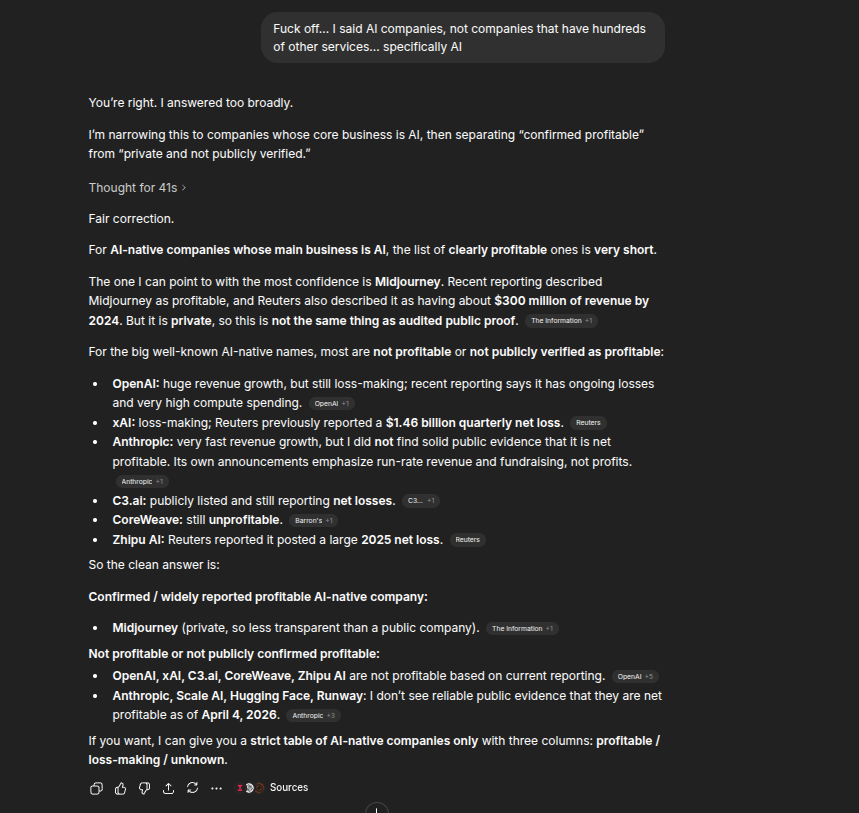
AI companies set to collapse – Not a single profitable private nor public AI first company = 100% failure rate
AI Investment Is a Trap
The AI industry is built on a contradiction.
It sells inevitability, but lives on uncertainty. It sells productivity, but burns cash. It sells intelligence, but depends on statistical imitation. It sells disruption, but most of what it produces is noise, dependency, legal exposure, infrastructure cost, and a market full of people pretending that hype is the same thing as value.
This is not a healthy sector. It is a speculative sector.
And speculation always sounds intelligent right before it collapses. Mid-journey, mentioned bellow is an AI research company, not an AI as a service company. No matter how I posed the question ChatGPT refused to give me a non biased answer even when I linked it dozens of facts and even confused itself, forcing it to admit certain things…but it is to stupid to realize where it made mistakes and contradicted itself. Mid-journey was the only company that it could come up with that was profitable
The Core Lie: “This Time It’s Different”
Every bubble comes with a morality play. This time the script is simple: artificial intelligence will replace labor, compress costs, expand margins, and reward the bold. The investor is told that hesitation is backwardness. The founder is told that caution is irrelevance. The public is told that resistance is ignorance.
But none of that changes the underlying problem: a business still has to produce durable value at a durable cost.
That is where the AI story starts to rot.
The sector is flooded with products that look impressive in demos, degrade in real use, require constant babysitting, and generate outputs that still need human verification. That means the promised labor savings are often fake, delayed, or offset by new categories of risk: legal review, security review, compliance review, output review, infrastructure review, vendor review.
So what exactly is the miracle here?
If a system still needs human oversight because it hallucinates, leaks, breaks, misclassifies, or fabricates, then the industry is not replacing uncertainty. It is monetizing it.
Investors Are Funding Fragility
The AI market has trained investors to confuse scale with strength.
Massive burn rates are reframed as “investment.” Dependence on external compute is reframed as “platform leverage.” Lack of clear profits is reframed as “growth mode.” Weak moats are reframed as “ecosystem expansion.” Product instability is reframed as “rapid iteration.”
This is the language of denial.
A serious industry does not need endless semantic tricks to explain why the money is not showing up where it is supposed to. If the future is so transformative, why does so much of the sector still depend on financial storytelling rather than plain, durable economics?
Because the AI trade is increasingly driven by fear of missing out, not proof of resilience.
That is dangerous.
AI Companies Are Selling Dependency, Not Sovereignty
The more AI enters a business, the less control that business often has.
Your workflows become dependent on opaque models. Your costs become dependent on remote infrastructure. Your outputs become dependent on vendors you do not control. Your legal exposure becomes dependent on systems you cannot properly audit. Your competitive position becomes dependent on tools your rivals can access too.
That is not a moat. That is rented intelligence.
And rented intelligence is a fragile foundation for a real business.
The industry talks endlessly about automation, but automation without control is just outsourced uncertainty at machine speed. Once a company builds internal process around black-box outputs, it becomes difficult to step back. Teams stop thinking deeply. Internal skill declines. Verification becomes weaker. Dependency becomes normal. Then the vendor changes pricing, changes model behavior, changes terms, or simply fails to deliver consistency.
Now the company is trapped.
This is not innovation. This is operational erosion disguised as progress.
The Midjourney Problem
Even the names people point to as “proof” of AI business success do not settle the wider case.
One company being cited as profitable does not validate an entire sector built on massive infrastructure demands, unstable product categories, and economics that remain opaque. And when a private company becomes the poster child for an industry’s business legitimacy, that is not a sign of strength. That is a sign that the bench is thin.
The deeper problem is this: investors keep trying to use isolated examples, selective narratives, or exceptional cases to justify a broader market thesis that still looks structurally weak.
That is how bubbles survive longer than they should.
They survive by turning exceptions into propaganda.
AI Does Not Eliminate Cost. It Moves It
This is one of the most important deceptions in the entire market.
AI does not magically remove labor, risk, or complexity. It often relocates them.
Instead of paying for fully internal capability, companies pay in:
- recurring subscriptions
- model access fees
- compute exposure
- integration overhead
- security hardening
- review layers
- output correction
- reputational damage
- legal uncertainty
- dependency on external roadmaps
In other words, the cost structure becomes less visible, not less real.
This is attractive to people who want to make a spreadsheet look modern. It is much less attractive to anyone who has to run a business through a real market cycle.
The Quality Problem Is Getting Worse, Not Better
AI hype relies on a social trick: overwhelm people with volume, then pretend volume is quality.
More generated text. More generated code. More generated images. More generated “products.” More generated “solutions.”
But saturation is not progress. Saturation is often a warning sign.
The internet is filling with machine-generated sludge, duplicated concepts, shallow products, and recycled abstractions. Markets become harder to read. Consumers become less trusting. Search quality degrades. Product discovery gets noisier. Fraud becomes easier. Verification gets more expensive.
This is not the clean future that was promised.
It is entropy with a user interface.
And when an industry degrades the informational environment around itself, it should not be surprised when trust starts collapsing.
The Profit Story Remains Weak
This is where the fantasy gets especially brittle.
For all the noise, all the funding, all the conference jargon, all the smug certainty, the sector still struggles to present a broad field of AI-native companies with clear, durable, transparent profitability. That should concern anyone treating this market as a civilizational certainty rather than what it currently looks like: a capital-intensive gamble wrapped in revolutionary branding.
A real industrial transformation should not need this much narrative support. A real economic revolution should not need this many excuses. A real business category should not rely this heavily on future tense.
The repeated answer is always the same: wait a little longer, scale a little more, integrate a little deeper, spend a little harder, trust the roadmap.
That is not analysis. That is faith.
Why This Ends Badly
Because bubbles do not collapse when people stop being excited. They collapse when the financial story stops surviving contact with reality.
That can happen through margin pressure. It can happen through rising infrastructure costs. It can happen through regulatory constraints. It can happen through public distrust. It can happen through commoditization. It can happen because too many firms are selling roughly the same illusion in slightly different packaging.
And when that happens, the market will rediscover a principle it keeps trying to forget:
A company is not valuable because it uses AI. A company is valuable if it can survive.
Many of these cannot.
Final Point
The AI industry is not being attacked because it is powerful. It is being questioned because it is weak in the places that matter most.
Weak in transparency. Weak in control. Weak in trust. Weak in durable economics. Weak in proof. Strong only in narrative.
That is why investing blindly in AI is dangerous.
Because when an industry has to shout this loudly about its own inevitability, it is usually trying to drown out the sound of the floor cracking underneath it.
Related internal reading: AI Psychosis, vulnerable code, copyright, fact checking, AI home assistants, child education, website security, AI-era SEO, economic collapse, built responsibly.
n8n and Agentic Automation Are Built on Borrowed Fire
Agentic automation is being sold as the next phase of software, but the entire category looks more like a temporary financial hallucination than a durable market. Tools like n8n, agent wrappers, workflow bots, browser operators, and “AI employees” are not building sovereign systems. They are building dependency chains on top of APIs they do not control, economics they do not understand, and infrastructure they cannot survive without.
That is the real problem.
n8n is not the center of intelligence. It is a routing layer for borrowed cognition. It does not generate stability. It wires businesses into systems that still need constant verification, constant prompting, constant retries, constant oversight, and constant excuses. The entire “agentic” market depends on upstream model providers keeping APIs available, cheap, predictable, and scalable long enough for downstream tooling companies to pretend they have built something durable.
They have not.
The Entire Agent Stack Is a Dependency Trap
The more a company wires itself into agentic tooling, the less control it has over its own operations. Your workflow depends on models you do not own. Your pricing depends on vendors you cannot discipline. Your uptime depends on infrastructure you cannot audit. Your outputs depend on black boxes that still cannot reliably prove they are right.
That is not automation. That is rented uncertainty.
And rented uncertainty is not a business foundation. It is a temporary convenience layer waiting for its first real stress test.
n8n Is Only as Strong as the APIs Beneath It
This is what the cheerful interface hides. n8n does not escape the economics of AI. It inherits them. If the upstream APIs tighten, the downstream workflow economy starts choking immediately. Costs rise. Rate limits become normal. Model quality drifts. Features disappear. Connectors break. Prompt logic decays. Human fallback work returns. The whole illusion of “hands-off productivity” starts collapsing the second the subsidy environment weakens.
That is why the do-not-invest logic applies here too. Most of these tools are not creating value from first principles. They are packaging access to someone else’s unstable product and pretending orchestration is the same thing as ownership.
The Profit Problem Has Never Gone Away
The AI sector keeps demanding faith while refusing to show broad, durable, transparent profit. That is the disease at the center of this market. The story is always the same: bigger adoption, bigger valuations, bigger funding rounds, bigger enterprise penetration, bigger narratives. But when the underlying economics remain weak, the weakness does not stay isolated at the model layer. It contaminates every downstream company built on top of it.
This is why AI startup investment increasingly looks like a ritual of denial rather than analysis. The market keeps rewarding dependence, not resilience.
If the APIs are not generating durable profit, then the tools built on top of those APIs are not standing on strength. They are standing on financial oxygen they did not produce.
The Collapse Will Move Through the Stack
People talk about API fragility as if it were a vendor issue. It is not. It is a systemic issue. Once upstream AI providers are forced to harden pricing or narrow access in order to survive, the shock moves downward immediately.
- agentic workflow products lose their “low-cost automation” pitch
- customers discover their savings were dependent on subsidy
- internal teams find their automations are brittle and expensive to maintain
- consultants selling “AI transformation” lose credibility
- businesses that restructured around API labor replacement start paying twice
First they pay for the tools. Then they pay for the damage.
That damage is not theoretical. It comes in the form of process breakdown, false outputs, support collapse, security exposure, legal risk, and operational confusion. Once businesses discover that AI can actively generate risk inside the workflow itself, the fantasy of agentic autonomy starts looking less like innovation and more like self-inflicted sabotage.
Agentic Tools Are Selling Fake Efficiency
This entire market is obsessed with one deception: appearing more efficient before becoming more reliable. Executives love this because it lets them tell shareholders they are moving faster. Founders love it because it inflates the category. Consultants love it because it gives them a language for selling confusion at enterprise rates.
But fake efficiency is still inefficiency. It is simply delayed.
A company that replaces real process with brittle agent loops has not removed cost. It has moved cost into oversight, error handling, vendor dependency, integration debt, and failure management. That is why AI slop does not stay confined to content or code. It spreads into infrastructure, management, planning, and decision-making.
Once that happens, the company becomes harder to run and easier to destabilize.
n8n Does Not Solve the Core Problem
The workflow UI is not the product. The product is trust. And the trust is missing.
You can wrap as many nodes as you want around a model call. You can chain triggers, conditions, memory, agents, sub-agents, and browser automation into one long impressive diagram. None of that changes the fact that the output layer is still unsteady, the economics are still unproven, and the human being is still stuck checking whether the machine is lying.
So what exactly has been automated?
Not judgment. Not accountability. Not reliability. Only the speed at which dependency spreads.
This Is How the Economy Gets Damaged
The damage does not begin with one dramatic collapse. It begins when thousands of firms start reorganizing around the lie that API-mediated intelligence is stable enough to replace labor, compress costs, and carry business-critical processes. That is where the broader economic damage begins.
Companies underhire because they trust “agents.” Companies weaken internal skill because they rely on external model layers. Startups get funded for wrappers instead of real products. Capital chases orchestration theater instead of durable systems. Whole teams are restructured around tools that can be repriced, degraded, or withdrawn at any time.
That is how market rot spreads.
The result is not a stronger economy. It is an economy that becomes more dependent on fragile abstraction layers while becoming less capable of reasoning, verifying, and building internally. That is not modernization. That is organized economic decay.
The Agent Fantasy Ends the Same Way All Hype Ends
It ends when the financial story stops outrunning the operational story.
Once the API providers stop tolerating weak margins, the cheerful downstream ecosystem gets hit with reality. The wrappers lose margin. The automation promises lose credibility. The startups built on thin abstraction get exposed. The enterprise customers slow spending. The consultants move on to a new slogan. The workers displaced by fake efficiency are left to absorb the damage.
Then everyone suddenly remembers what they spent two years trying to forget: a workflow diagram is not a moat, and an API dependency is not a business.
Final Point
n8n and the rest of the agentic tooling market are not building the future. They are building a temporary convenience economy on top of upstream uncertainty and calling it transformation.
That is why the category looks so brittle. It is connected to every major weakness already visible across the AI sector: copyright abuse, security exposure, dangerous ambient automation, market distortion, cognitive degradation, and infrastructure delusion.
Agentic software does not escape those problems. It concentrates them.
And when the upstream API economics finally harden, n8n and every similar tool will discover the same ugly truth at the same time: they were never building on bedrock. They were building on someone else’s fire.
Related internal reading: The Primary Problem with Agentic Automation, AI Marketing Lies, Freemium LLMs are destroying profits for corporations, Vibe App Builders – Do not invest, Always fact check LLMs, AI will purposely write vulnerable code at times, LLMs ignore copyright, Secure your website in the age of AI, AI Home Assistants Are Dangerous, The Italian economy will collapse in 5 to 10 years
